'/%3E%3Cpath%20fill='%23b2b2b2'%20d='M241%20382q0%2016%2017%2026%2017%2011%2042%2011t42-11q16-11%2017-26V269H241'/%3E%3Cpath%20fill='%239f7e00'%20d='M241%20379q0%2014%208%2023%209%209%2021%209%2014%200%2021-9%209-9%209-23V269h-59'/%3E%3Cpath%20d='M241%20339v-70h59v110q0%2014-9%2023l-6%205v-68h-15v72q-8%200-14-4v-68zm59%2040c0%2022%2015%2032%2029%2032%2021%200%2030-18%2030-32v-40h-59'/%3E%3Cpath%20fill='%239f7e00'%20d='M266%20277v5h2v12h-3v-5h2v-5h-9v5h2v5h-4v9h3v18h-5v10h34v-10h-5v-18h3v-9h-4v-5h2v-5h-9v5h2v5h-3v-12h2v-5zm42%20101q0%2010%206%2017%206%206%2015%207%2010-1%2016-7%206-7%206-17v-29h-43'/%3E%3Ccircle%20fill='%230044ad'%20cx='329.5'%20cy='372'%20r='6'/%3E%3Cellipse%20fill='%230044ad'%20cx='300'%20cy='340'%20rx='16'%20ry='21'/%3E%3C/svg%3E)

;)
A spice shipment can clear every document and still arrive unsellable.
Caked cardamom. Turmeric with mold blooming through the bag. A container of black pepper held at the border over a contaminant nobody tested for at origin. The paperwork was clean in all three cases. The cargo was not. So the real question isn’t only which forms to file. It’s how to import and export spices internationally without losing the product somewhere between your supplier’s warehouse and your own.
Importing and exporting spices internationally means classifying the product correctly under the Harmonized System, meeting the destination market’s food-safety and plant-health requirements, verifying your supplier and testing the product before it ships, and protecting the cargo from moisture and temperature damage in transit. Get any one of those wrong and a shipment can sit in customs, fail testing, or arrive degraded no matter how clean the documentation was.
Most guides on this topic run supplier, paperwork, customs, delivery. That sequence describes how a shipment moves. It doesn’t describe what decides whether the product is still worth selling when it lands. This guide covers both.
In this guide:
- How international spice trade works
- Classifying spices under the Harmonized System
- Regulations and standards that apply
- Sourcing and vetting a supplier
- What to test before shipment
- Required documentation
- Packaging for international transit
- Moisture: the biggest hidden risk
- Choosing a shipping method
- Incoterms
- Landed cost
- Requirements by destination market
- Risk profiles by spice
- Mistakes to avoid
- Shipping checklist
How Does International Spice Trade Work?
Spices move as agricultural food commodities, which means every shipment answers to three separate systems at once: customs classification, food safety, and plant health. Those systems have different rulebooks, different agencies, and different failure modes. A shipment can satisfy one and be stopped by another.
In trade terms, spices break into seeds, fruits, roots, bark, and flower buds, and they sit within the wider category of agricultural goods shipped in containers. Each behaves differently in transit, which matters more than most importers expect once cargo is sealed in a container.
The market itself is large, though you should treat any single figure with care. Estimates vary by roughly 4x depending on whether the source counts raw spices only or includes blends, seasonings, and extracts. Fortune Business Insights puts the global spices market at $21.14 billion in 2025, rising to $21.98 billion in 2026. Other credible sources land well outside that range using different scopes.
On the export side, India leads, and the shape of that lead is widely misreported. India shipped $4.72 billion in raw spice exports in FY2024-25 according to the Spices Board of India. India also produces more than 40% of world spice volume while accounting for only about 9% of global export value. Production share and export share are different numbers measuring different things, and most content on this topic blurs them together.
Vietnam dominates pepper specifically, with 2025 pepper exports alone reaching $1.515 billion, up 24.4% year over year on a genuine supply shortfall. Growers cut new planting after the 2018 price collapse, and pepper vines take 3 to 4 years to mature, so the shortage has a fixed floor on how quickly it can resolve. Indonesia leads in cloves, at 55.1% of global exports, and in nutmeg.
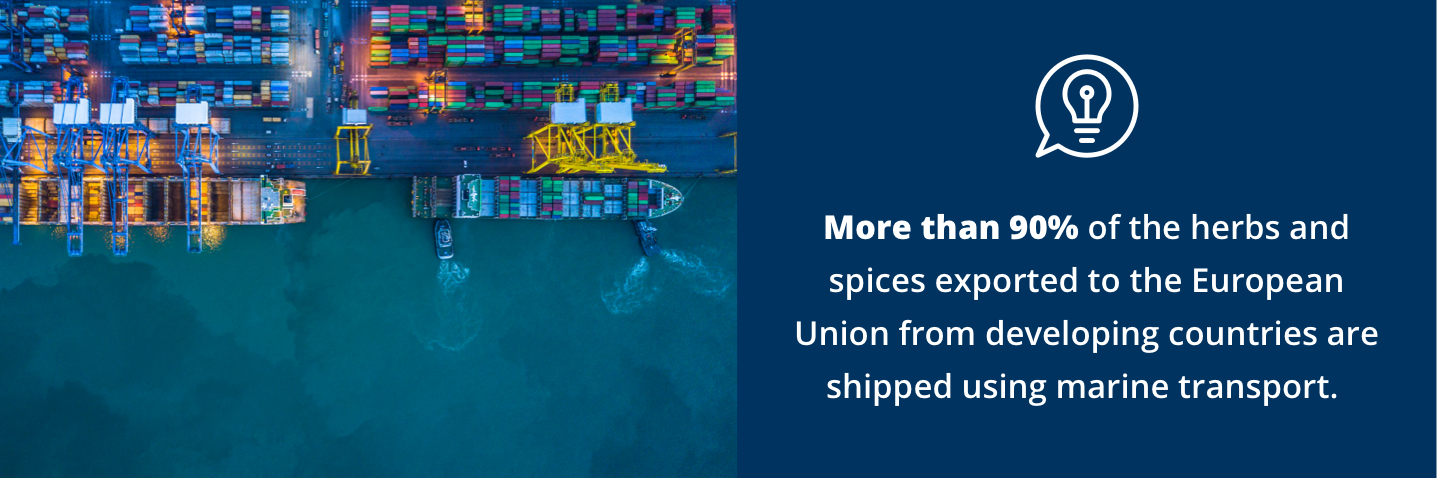
On the import side, the United States is the largest single-country importer. The EU brought in 339,800 tonnes from outside the bloc in 2023, down from 397,000 tonnes in 2022, per Eurostat. The UAE is worth understanding correctly: it functions mainly as a re-export hub rather than a consumption market, with an estimated 45% to 60% of landed spice volume moving on to other Gulf states and East Africa.
How Do You Classify a Spice Under the Harmonized System?
Your HS code sets your duty rate, drives which permits and inspections apply, and determines which food and plant-health rules attach to the shipment, so an incorrect code creates problems well beyond a wrong tariff bill.
Classification depends on the physical state of the product: whole against crushed against ground, single spice against blend, processed against unprocessed. The same botanical product can sit under different codes in different forms.
Here are the current codes for common spices:
| Spice | HS Code | Note |
|---|---|---|
| Black pepper (whole) | 0904.11 | |
| Dried chili and capsicum | 0904.21 | |
| Cinnamon (whole) | 0906.11 / 0906.19 | Ceylon cinnamon and other cinnamon classify separately |
| Cloves (whole) | 0907.10 | |
| Nutmeg (whole) | 0908.11 | |
| Cardamom (whole) | 0908.31 | |
| Coriander seeds (whole) | 0909.21 | |
| Cumin seeds (whole) | 0909.31 | Commonly misfiled as 0909.21, which is coriander |
| Ginger (whole) | 0910.11 | |
| Turmeric | 0910.30 | Sometimes still listed as 0910.10, which no longer exists in the current HS |
Two of those deserve a flag because they show up wrong in circulating trade content. Cumin is 0909.31, not 0909.21. And turmeric is 0910.30. The code 0910.10 was ginger’s classification before the 2017 HS revision and has not existed since.
These are 6-digit international base codes. Countries add further digits, so confirm the national tariff line for your destination before filing.
A workable classification sequence:
- Identify the exact botanical product and its physical form.
- Confirm whether it ships whole, crushed, or ground.
- Confirm whether it’s a single spice or a blend.
- Locate the 6-digit international heading.
- Check the importing country’s extended national code.
- Verify the duty rate that attaches to that line.
- Check whether a free trade agreement offers preferential treatment.
- Confirm with a licensed broker or a binding customs ruling when classification is genuinely uncertain.
If you re-export or process spices rather than selling them domestically, duty drawback (19 U.S.C. §1313) and bonded warehousing (19 U.S.C. §1555) are established CBP mechanisms for recovering or deferring duty. Neither is spice-specific, but importers leave both on the table more often than they should.
Which Regulations and Standards Apply to Your Shipment?
Spice shipments answer to international food standards, the destination country’s food-safety regulator, its plant-health authority, and its customs service, and naming the specific standard matters far more than citing the organization.
Most content on this topic name-drops Codex Alimentarius without saying which standard applies. The specific ones exist and they’re citable:
- CXC 42-1995, Code of Hygienic Practice for Spices and Dried Aromatic Plants and Herbs. The general hygiene framework.
- CXC 78-2017, Code of Practice for the Prevention and Reduction of Mycotoxin Contamination in Spices. This is the one that sets the moisture control point discussed later in this guide.
- Commodity-specific quality standards, including CXS 326 (pepper), CXS 327 (cumin), CXS 351 (saffron), CXS 352 (nutmeg), CXS 353 (chili and paprika), CXS 357 (cardamom), and CXS 359 (turmeric).
Codex sets international food-safety and quality benchmarks that national authorities adopt or adapt. It does not operate a universal commercial grading system. Commercial grades also come from buyer specifications, trade associations, and national standards, and your contract governs which applies.
In the United States, precision about the agency matters:
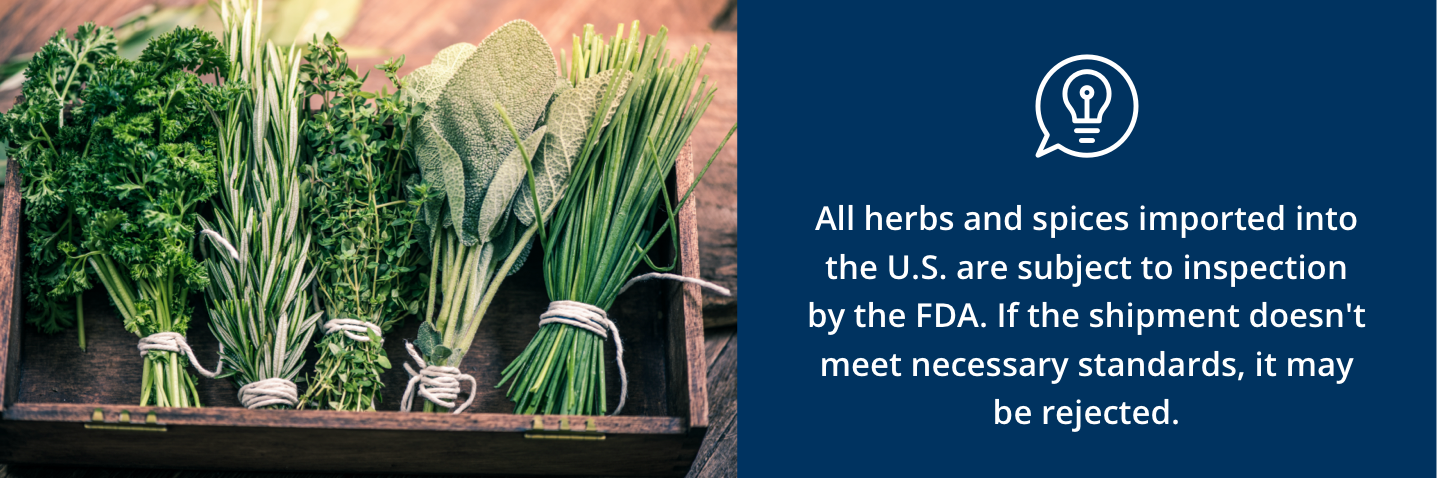
- FDA is the food-safety regulator for spices. Spices are not meat, poultry, or egg products, so USDA’s Food Safety and Inspection Service has no role here.
- APHIS handles plant-pest and phytosanitary risk, which is a separate question from food safety.
- AMS administers the National Organic Program.
Referring to all of this as “USDA oversight” is imprecise enough to send an importer looking in the wrong place.
If you source from India, the dominant origin, the exporter-side requirements are their own stack: Spices Board of India registration (mandatory for spice exporters), an FSSAI license, a DGFT Importer-Exporter Code, and origin or inspection certificates through APEDA and the Export Inspection Council.
Other markets have their own regimes, and this list is not exhaustive: most GCC states require Halal certification and Arabic labeling, the UK operates separately from the EU post-Brexit, and Australia and New Zealand apply their own biosecurity permits and FSANZ labeling rules.
One dated-claim trap worth knowing: the current edition is Incoterms 2020, published by the International Chamber of Commerce. There is no 2026 edition, and the next revision isn’t expected before roughly 2029. Any source citing “Incoterms 2026” is using the year for search traffic rather than describing something real.
How Do You Source and Vet a Reliable Spice Supplier?
Supplier verification is where most preventable spice problems get solved or locked in, because contamination, adulteration, and moisture damage all originate upstream of the container.
Check legitimacy first: business registration, export history, verifiable references, current certifications, and real facility information.
Then food safety: HACCP or FSSC 22000 systems, GMP compliance, accredited laboratory testing, lot traceability, and a documented recall procedure.
The single most useful thing you can do is issue a written product specification and hold the supplier to it. A buyer-ready spec sheet covers:
- Botanical and common name
- Origin
- Grade
- Mesh size
- Moisture content
- Microbiological limits
- Foreign-matter limits
- Pesticide-residue limits
- Packaging format
- Shelf life
- Storage conditions
Commercial terms follow: minimum order quantity, lead time, production capacity, and payment structure. Sight letters of credit, cash against documents, T/T in advance, and payment on delivery are all standard in this trade. For a new supplier relationship, advance payment or an irrevocable letter of credit reduces seller-side payment risk relative to open account. Build in price-adjustment clauses for currency movement and raw-material swings, along with defined penalties for non-compliance.
Adulteration deserves specific attention in spices, more than in most food categories. The EU’s own coordinated authenticity work found samples at risk of adulteration in pepper, cumin, oregano, saffron, and other herbs and spices. High-value products are the obvious targets, but dilution and substitution reach further down the price ladder than buyers expect.
Practical controls: certificates of analysis tied to specific lots, independent laboratory testing rather than supplier-supplied results alone, DNA or chemical fingerprinting for high-value products, lot-level traceability, and documented chain of custody.
What Should Be Tested Before a Shipment Leaves Origin?
Test at origin, before the container is sealed, because a contaminated shipment discovered at the destination border is a total loss plus disposal costs, while the same problem caught at the supplier’s facility is a rejected lot.
| Test | Why it matters |
|---|---|
| Salmonella | The leading food-safety concern in low-moisture foods |
| Yeast and mold | Signals a storage or moisture problem upstream |
| Aflatoxins and ochratoxin A | Mycotoxin risk, regulated in most destination markets |
| Pesticide residues | Must clear destination-market maximum residue limits |
| Heavy metals, especially lead | An active enforcement area, see below |
| Foreign matter | Both a quality and a regulatory requirement |
| Moisture and water activity | The controlling variable for mold and shelf life |
| Volatile oil content | The measurable proxy for flavor and aroma quality |
| Adulterants | Substitution, dilution, and added coloring |
The moisture number that governs everything else
Codex CXC 78-2017 sets water activity below 0.65 as the control point for preventing mycotoxin contamination in dried spices. That single figure is worth internalizing, because surveys of commercially stored spices routinely measure water activity between 0.6 and 0.75.
Read those two numbers together. A meaningful share of spice cargo is already sitting at or above the safety threshold before it ever encounters a shipping container. There is no moisture budget left for a bad transit.
What the contamination record shows
Low moisture does not mean low risk, and the enforcement history makes that concrete.
Salmonella. FDA data puts average Salmonella prevalence in imported spice shipments at 6.6%, against under 1% at retail. That gap exists because most bulk shipments receive pathogen-reduction treatment domestically before they reach consumers. The import-stage number is the one that matters to you.
Heavy metals. The WanaBana cinnamon applesauce contamination produced 566 confirmed illness cases across 44 states according to CDC’s MMWR, with 55% of cases in children under 2. FDA found lead alongside lead chromate, a marker of deliberate adulteration rather than environmental contamination. This is not a closed case: as of October 31, 2025, FDA had flagged 18 further ground cinnamon brands with elevated lead, unconnected to the original incident. In November 2025, Codex adopted new international lead limits of 2.5 mg/kg for cinnamon and cassia and 2.0 mg/kg for dried culinary herbs.
Adulteration with dyes. Sudan dye contamination in chili products remains active, with 39 RASFF notifications between 2014 and 2024. India appears most frequently in that record, and a 2024 Taiwan case implicated Chinese-origin product.
Ethylene oxide. The sesame contamination crisis triggered the largest food recall operation in EU history. Compliance has improved and enforcement has stepped down accordingly, from 50% of consignments checked to 30% and then to 20%.
Treatment options and their tradeoffs
Steam and vacuum steam pasteurization is the method most buyers now prefer. A peer-reviewed study achieved 5-log Salmonella reduction on whole black peppercorns and cumin seeds in 70 to 83 seconds, with post-treatment water activity between 0.33 and 0.51, comfortably under the Codex threshold.
Irradiation is FDA-approved specifically for spices, herbs, and seasonings under 21 CFR 179.26, at a maximum dose of 30 kGy.
Phosphine fumigation is APHIS-approved and widely used, though resistance among stored-product pests is a documented and growing limitation.
Methyl bromide carries a wrinkle worth knowing. Quarantine and pre-shipment use was never part of the Montreal Protocol phase-out, so it sits in a permanent exemption category. India still permits it for export treatment under those rules, which means a shipment can legally leave origin fumigated with a substance the destination market has banned for domestic use.
On cleanliness specifically, the American Spice Trade Association publishes numeric filth limits designed to meet or exceed FDA’s own Defect Action Levels. Ground paprika, for example, is capped at 75 insect fragments and 11 rodent hairs per 25g sample. Writing ASTA specifications into your purchase contract gives you a defined, measurable standard to reject against.
What Documents Do You Need to Import or Export Spices?
The commercial document set is standard across most food commodities, but spices add food-safety filings that catch first-time importers, and any mismatch between your documents and your actual cargo will hold the shipment.
| Document | What it does | Who issues it |
|---|---|---|
| Commercial invoice | Declares value, parties, terms, and Incoterm | Exporter |
| Packing list | Reconciles quantities, weights, and packaging detail | Exporter |
| Bill of lading or air waybill | Evidence of carriage and title to the goods | Carrier or freight forwarder |
| Certificate of origin | Supports origin declaration and FTA duty claims | Exporter or authorized issuer |
| Phytosanitary certificate | Confirms plant-health compliance where required | Exporting country’s plant-protection authority |
| Certificate of analysis | Documents lab-verified safety and quality | Accredited laboratory |
| Insurance certificate | Documents coverage per the sale terms | Insurer |
On phytosanitary certificates, be careful with blanket statements in either direction. Whether one is required depends on the specific commodity, its form, and the origin and destination pair. APHIS states plainly that import requirements vary by commodity and country. Assuming a certificate is always needed wastes time and money. Assuming it never is will stop your shipment.
Two US filings deserve their own attention, because they’re where importers new to food most often get caught:
Prior Notice (21 CFR Part 1, Subpart I) requires electronic notice to FDA before an imported food shipment arrives. FDA must confirm receipt before arrival or the shipment is held at the port.
FSVP, the Foreign Supplier Verification Program, requires the importer to maintain a written, supplier-specific verification program. For spices, that program needs to address Salmonella, heavy metals and lead, economically motivated adulteration, and aflatoxins as identified hazards.
Behind both sits the live enforcement machinery: Import Alert 99-19 covers Salmonella and Import Alert 99-42 covers heavy metals, with cinnamon-specific entries. Products under an import alert can be detained without physical examination, which shifts the burden of proof onto you.
If you sell the product as organic, note that two separate things have to be true. The product must be organically produced and certified at origin, and you must hold the documentation that lets you legally market it as organic in the destination country. USDA NOP and EU Organic are the relevant regimes, and each shipment needs its own paper trail.
How Should Spices Be Packaged for International Shipping?
Spice packaging has to do two jobs that pull in different directions: block moisture and oxygen from reaching the product, and avoid becoming a moisture source itself.
Think in three layers.
Primary packaging touches the spice: food-grade bags, laminated pouches, barrier films, and vacuum packaging.
Secondary packaging groups and protects: cartons, cases, sacks, and drums.
Tertiary packaging handles the unit load and its environment: pallets, stretch wrap, container liners, desiccants, and dunnage.
A common terminology error worth correcting
Modified atmosphere packaging gets credited with preserving spice aroma in a lot of published guidance. The mechanism doesn’t apply. MAP works by managing the oxygen and carbon dioxide balance around produce that is still respiring. Dried spices don’t respire.
What protects aroma and color in dried spices is vacuum packing, nitrogen flushing, or both, inside an oxygen and moisture barrier laminate such as an EVOH or polyamide multilayer film. The goal is excluding oxygen to prevent oxidative degradation of volatile aromatic oils and pigments. That’s a different mechanism with different material requirements, and specifying the wrong one gets you the wrong packaging.
Form changes the risk profile
Ground spices present far more surface area than whole seeds, pods, or bark, so they reabsorb ambient moisture faster once exposed. Worth stating precisely: faster reabsorption is not the same as always being wetter. One comparative study found ground samples with slightly lower average water activity than whole (0.607 against 0.642), most likely reflecting a processing difference rather than a packaging one. Plan around the rate of reabsorption, not an assumption about starting condition.
Spices share this hygroscopic profile with other commodities, which is why shipping coffee internationally runs into the same failure modes. Oleoresins sit at the opposite end. Because these concentrated extracts ship in sealed rigid drums or cans, the product never contacts container air, which largely removes condensation from the risk picture for that format.
Why Is Moisture the Biggest Hidden Risk in Spice Shipping?
Because the moisture that damages spice cargo usually comes from inside the container, not from outside it, which means a watertight container and clean bill of lading tell you nothing about whether your cargo arrived dry.
This is the part of international spice logistics that gets least attention relative to how much product it destroys.
Where container condensation actually comes from
According to the Transport Information Service, operated by GDV, the German marine insurers’ association, the largest sources of condensation in closed containers are always the cargo itself, its packaging, the wooden flooring, and any hygroscopic auxiliary packaging materials. Incoming ambient air is typically lower in humidity than the air already inside the container.
Follow that through and the practical implication is uncomfortable. Jute bags, cardboard cartons, and wood pallets are themselves moisture reservoirs. Bagged or cartoned spice cargo is not protected by virtue of not being bulk. The packaging can be part of the problem.
The mechanism is straightforward once you see it. Warm, moisture-laden air inside the container meets internal surfaces that have cooled below its dew point, usually as the vessel moves between climate zones or through the day-night cycle. Water condenses on the ceiling and walls, then falls back onto the cargo. That’s container rain, and it’s a temperature-driven event, not a leak.
The transport conditions spices need
CBI, the Netherlands’ government trade promotion body, publishes specific targets for spice transport: 10 to 25°C, not exceeding 30°C, and 50% to 60% relative humidity, not exceeding 70%. Above 70% RH, CBI warns of moisture absorption, mold growth, and clumping. CBI also recommends desiccant packs, moisture-absorbing materials, and food-safe gel bags to absorb condensation caused by temperature fluctuation.
Now connect that to the Codex figure from the testing section. Cargo commonly leaves origin at water activity 0.6 to 0.75 against a 0.65 control point. Put that product in an environment above 70% RH for a 30 to 45 day ocean transit and the outcome is predictable.
Desiccant capacity should be calculated, not guessed
Two published standards exist for sizing moisture protection, and neither supports the common practice of throwing a fixed number of bags into a container.
MIL-D-3464E, the US military specification, defines a desiccant unit by performance: 3.00g of water vapor adsorbed at 20% RH and 25°C, or 6.00g at 40% RH and 25°C.
BS 1133-19, the British Standard, provides a sizing formula built from barrier surface area, the water-vapor transmission rate of that barrier, transit duration, and the weight of hygroscopic packaging in the load.
Both point at the same conclusion. Required desiccant capacity is a function of your specific cargo, packaging, route, season, and transit time. A container of jute-bagged turmeric crossing the Indian Ocean in monsoon season and a container of drummed oleoresin on a short northern route are not the same problem and should not receive the same protection.
Container preparation that reduces claims
Before loading:
- Inspect for holes, leaks, standing moisture, rust, residue, and odors
- Check door seals
- Confirm the container is clean and dry
- Load only dry cargo in dry packaging
During loading:
- Keep cartons and pallets off the container walls where the load allows
- Use appropriate liners for the cargo format
- Secure the load against movement
- Photograph container condition, loading, seals, and desiccant placement
During transit:
- Size desiccant capacity to route, season, duration, and cargo weight
- Use absorbent ceiling protection where container rain risk is material
- Consider temperature and humidity data loggers for high-value or claim-sensitive cargo
That photographic record matters more than it sounds. When a moisture claim goes to an insurer, documented pre-load condition and protection placement is often the difference between a paid claim and a denied one.
Matching protection to the specific threat
Different failure modes call for different systems, which is why our moisture control solutions are designed around the cargo rather than supplied as a standard kit.
Hybag, Hyblanket, and Hypad address moisture, mold, and mycotoxin risk directly. Where cargo is already near the Codex water activity threshold, active desiccant capacity is what keeps it from crossing.
Temcore addresses the temperature swing that triggers condensation in the first place. Container rain is a dew-point event driven by temperature cycling, so damping that swing works on the cause rather than the symptom.
Container liners provide a barrier against contamination, pests, and secondary moisture. Given that spices readily absorb odors and that stored-product pests are a documented and current phytosanitary concern, that barrier does more than one job.
For the underlying mechanics of how condensation forms and cycles inside a sealed container, see our detailed explanation of why moisture damage happens during export.
If you’re shipping moisture-sensitive spice cargo and want protection sized to your actual route and packaging rather than a standard allocation, request a solution assessment and we’ll work through the specifics with you.
How Do You Choose a Shipping Method?
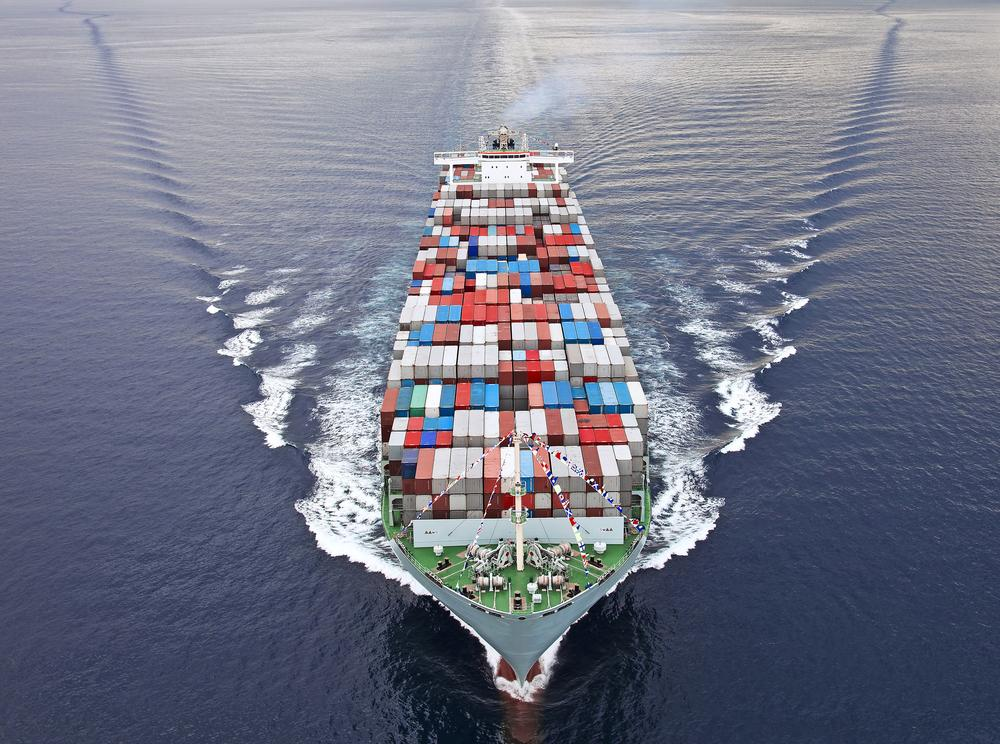
Ocean freight carries the overwhelming majority of spice volume on cost, and the tradeoff you’re accepting is 30 to 45 days of exposure to the container environment.
| Method | Best for | Advantage | Main risk |
|---|---|---|---|
| Ocean FCL | Large single-origin shipments | Lowest unit freight cost | Long transit exposure |
| Ocean LCL | Smaller commercial volumes | Lower volume commitment | More handling, shared container conditions |
| Air | High-value or urgent cargo | Speed | Cost |
| Truck or rail | Regional and cross-border trade | Flexibility and cost efficiency | Border delays, route limitations |
Realistic ocean transit times run 25 to 45 days from India to the US and 20 to 40 days from Vietnam to the US. Air freight moves in 3 to 7 days.
Be skeptical of unusually short lead-time figures quoted for international spice shipments. A 1 to 5 day figure describes customs clearance and final-mile delivery after arrival, which is a real and separate segment of the timeline, not total shipment lead time.
One current variable belongs in your planning. Red Sea disruption continues to reroute traffic, with roughly 60% of pre-crisis Red Sea volume still diverting via the Cape of Good Hope as of January 2026. That adds 10 to 14 days to Asia to Europe lanes. A practical Asia to Rotterdam estimate now runs 35 to 50 days rather than the pre-crisis 30. Longer transit means more temperature cycles, which means more condensation opportunity, so the routing change has a temperature stabilization consequence and not just a scheduling one.
What Incoterm Should You Use for a Spice Shipment?
The Incoterm decides who carries cost and risk at each stage, and the most common mistake is treating it as shipping shorthand rather than as an allocation of liability.
| Incoterm | What it means in practice |
|---|---|
| EXW | Buyer takes on nearly all logistics responsibility from the supplier’s door |
| FOB | Seller delivers to the vessel and handles export clearance, common in ocean freight |
| CIF | Seller arranges freight and insurance to the destination port |
| DAP | Seller delivers to the named destination, excluding import clearance and duties |
| DDP | Seller carries most delivery and import obligations |
Two points that save arguments later.
The current edition is Incoterms 2020. There is no 2026 edition.
And the Incoterm is not a substitute for a detailed sales contract. It allocates cost and risk transfer. It says nothing about product quality, testing obligations, packaging specification, or delivery schedule. Those belong in the contract, and for spices the packaging and testing clauses are where the real money sits.
Worth thinking through: whoever bears risk during ocean transit has the strongest interest in cargo protection. If you buy FOB, that’s you from the moment the goods cross the ship’s rail, which makes container preparation your problem regardless of who loaded it.
How Much Does It Cost to Import Spices?
Landed cost, not supplier price, is the number that determines whether a spice import is viable, and the gap between the two is wider in spices than in most commodities because of testing and compliance overhead.
The full stack includes product cost, origin transport, export documentation, inspection and laboratory testing, packaging, freight, cargo insurance, customs duties, tariffs, brokerage fees, port and terminal charges, destination transport, storage, compliance costs, and financing costs.
Here’s why the cheapest FOB price frequently loses. Suppose Supplier A quotes below Supplier B. Supplier A also requires a higher minimum order, sits further from a major port, has no existing relationship with your destination market’s requirements, and has a testing history that means you’ll run additional verification on every lot. Supplier B costs more per kilo, packs to a barrier specification that survives the transit, and clears customs without repeated holds. Supplier B can easily land cheaper.
On duties and tariffs, a word of caution rather than a number. US tariff policy on imported goods changed multiple times during 2026, including a February 2026 Supreme Court decision striking down IEEPA tariff authority, followed by further changes in the months after. Any specific rate published in a guide like this one would likely be wrong by the time you read it.
Verify current duty rates and applicable trade actions against the destination country’s tariff schedule, dated to your shipment, and confirm with your customs broker before you commit to a landed-cost model. Treat any tariff figure you find in published content, including from otherwise reliable sources, as needing a fresh check.
What Are the Import Requirements in Major Destination Markets?
There is no universal international requirement set. What applies to your shipment depends on the combination of product, form, origin, destination, intended use, and any claims you make about it.
United States
- FDA Prior Notice must be filed and confirmed before arrival.
- FSVP requires a named importer with an FDA-recognized unique facility identifier, along with name and email, on each food line entry.
- Country-of-origin marking requires foreign articles to be legibly marked in English, subject to defined exceptions.
- APHIS involvement depends on the commodity, its packaging, origin, and port of entry, rather than applying uniformly.
- Importer responsibility does not transfer to your broker. CBP is explicit that a customs broker can handle the administrative work while the importer remains responsible for compliance. This surprises people, usually at a bad moment.
European Union
- Pesticide MRLs under Regulation 396/2005 apply to any food placed on the EU market, regardless of where it was produced.
- Contaminant limits under Regulation 2023/915 cap aflatoxin B1 at 5.0 μg/kg and total aflatoxins at 10 μg/kg for chili, pepper, nutmeg, ginger, and turmeric. Note that Codex’s corresponding limit is roughly double and is not yet finalized, so the two are not interchangeable.
- Increased official controls under Regulation 2019/1793 remain the live instrument, amended roughly every 6 months. Sesame from India and black pepper from Brazil currently appear on the list. In a positive development, nutmeg, vanilla, and cloves from India were delisted in the January 2026 amendment following satisfactory compliance records.
- Phytosanitary certification is required for listed plant products, issued by the exporting country’s national plant-protection organization.
If EU-India trade matters to your planning, note the tense carefully: the EU-India free trade agreement was concluded in January 2026 but is not yet in force. Ratification should bring it into effect around early 2027.
Other markets
Treat each of these as its own regime rather than an extension of US or EU rules:
- GCC and Middle East: Halal certification, Arabic and English labeling, and product registration requirements. Remember the UAE’s role as a re-export hub when structuring onward movement.
- United Kingdom: verify separately from EU requirements post-Brexit.
- Canada, Australia, New Zealand, and Japan: biosecurity, residue, and labeling requirements are market-specific.
Requirements change, and they vary by product form and origin in ways a general guide can’t fully capture. Confirm current requirements with your customs broker, your importer of record, and the destination market’s competent authority before shipping.
Common Spices and Their Shipping Risk Profile
These are potential considerations to plan testing and protection around, not universal regulatory requirements. Your specific origin, form, and destination determine what applies.
| Spice | Watch for |
|---|---|
| Black pepper | Microbial contamination, moisture, pesticide residues |
| Chili and paprika | Pesticide residues, mycotoxins, color stability, Sudan dye adulteration |
| Turmeric | Adulteration, heavy metals |
| Cumin and coriander | Pesticide residues, purity and substitution |
| Cinnamon | Heavy metals, particularly lead |
| Cardamom | Aroma preservation, insect infestation |
| Ginger | Moisture, mold |
| Cloves and nutmeg | Mycotoxins, volatile oil preservation |
| Saffron | Authenticity, high-value cargo security |
What Mistakes Should You Avoid When Importing or Exporting Spices?
Most failed spice shipments trace back to a decision made before the cargo moved, not to something that went wrong in transit.
- Choosing a supplier on price alone. The cheapest quote often carries the highest landed cost once you count testing, holds, and rejections.
- Not defining a written product specification. Without one you have no measurable basis to reject a substandard lot.
- Using the wrong HS code. Cumin and turmeric are misclassified often enough that the wrong codes circulate freely in published guidance.
- Assuming phytosanitary requirements are universal, in either direction. They depend on commodity, form, origin, and destination.
- Skipping pre-shipment testing. Discovering contamination at the destination border converts a rejected lot into a total loss plus disposal costs.
- Specifying the wrong packaging mechanism. MAP does not protect dried spices. Barrier film with vacuum or nitrogen flushing does.
- Ignoring container condensation. The moisture that damages cargo usually originates inside the container, so a sound container is not sufficient protection.
- Sizing desiccant by habit. Capacity should follow cargo, packaging, route, season, and duration.
- Choosing an Incoterm without understanding risk transfer. If you carry the risk during transit, cargo protection is your exposure.
- Assuming your broker carries your compliance liability. CBP does not see it that way.
International Spice Shipping Checklist
Before ordering
- Confirm destination market requirements for your specific product and origin
- Confirm the HS code and national tariff line
- Vet the supplier and issue a written specification
- Obtain and test representative samples
- Build a full landed-cost model
- Verify current duty rates and trade actions
Before shipping
- Approve the packaging specification against the transit profile
- Confirm all documentation matches the actual cargo
- Confirm the Incoterm and who carries transit risk
- Arrange cargo insurance
- Inspect the container and document its condition
- Install moisture protection sized to the route and season
- File Prior Notice and confirm FSVP records are current
On arrival
- Clear customs
- Inspect packaging condition before unloading
- Verify quantity against the packing list
- Check product condition, including moisture and caking
- Photograph any damage before the cargo moves
- Maintain lot records for traceability
Protect Spice Cargo Through Every Stage of Transit
Importing and exporting spices internationally comes down to five things done properly: correct tariff classification, destination-specific regulatory compliance, verified supplier quality, a realistic landed-cost model, and cargo protection matched to the actual transit.
The first four are well covered by brokers, consultants, and trade bodies. The fifth is where most of the preventable loss sits, and it’s the least discussed. A shipment that clears customs on time and arrives caked, moldy, or aroma-degraded has failed just as completely as one held at the border, but nobody files a compliance report about it.
The specific numbers are worth carrying with you. Water activity below 0.65 as the Codex control point. Real-world cargo commonly at 0.6 to 0.75. Transport targets of 10 to 25°C and 50% to 60% relative humidity. A 30 to 45 day ocean transit where the cargo and its own packaging are the primary moisture source. Those figures define the problem precisely enough to engineer against.
If you’re moving spices and want protection designed around your cargo, route, and packaging rather than a standard allocation, talk with our export protection team about what your shipments need.
Frequently Asked Questions
Do I need a phytosanitary certificate to import spices?
It depends on the specific commodity, its form, and the origin and destination pair. APHIS states that import requirements vary by commodity and country, and processed or ground spices are often treated differently from whole or raw plant material. Check the requirement for your exact product and route rather than assuming one applies universally.
How long does it take to ship spices internationally?
Ocean freight typically runs 30 to 45 days, with India to the US at roughly 25 to 45 days and Vietnam to the US at 20 to 40 days. Air freight moves in 3 to 7 days. Asia to Europe lanes currently run longer, around 35 to 50 days, because of continued Red Sea rerouting via the Cape of Good Hope.
What documents do I need to import spices into the US?
The standard commercial set covers the commercial invoice, packing list, bill of lading, and certificate of origin. Food imports add FDA Prior Notice before arrival and FSVP records identifying the importer. A certificate of analysis, phytosanitary certificate, and organic documentation may also apply depending on your product, origin, and claims.
How can I prevent moisture damage during ocean shipping?
Start by recognizing that most container moisture comes from the cargo and its own packaging rather than from outside. Load only dry product in dry packaging, inspect and document container condition before loading, use barrier packaging suited to the spice format, and size desiccant capacity to your route, season, transit duration, and cargo weight rather than using a fixed bag count.
Can I import organic spices without certification?
No. To market spices as organic in the destination country, the product must be certified organic at origin and you must hold documentation that satisfies the destination market’s organic regime, such as USDA NOP or EU Organic. Organic production and the legal right to make an organic claim are two separate things, and each shipment needs its own traceable paper trail.
Does grinding a spice change its shipping risk?
Yes. Ground spices expose far more surface area than whole seeds, pods, or bark, so they reabsorb ambient moisture faster once exposed. That said, faster reabsorption does not automatically mean higher moisture at loading. Plan protection around the rate at which ground product takes on moisture during transit, not around an assumption about its starting condition.


