

;)
Getting a shipping container from one place to another takes more than a truck. You need equipment that fits the delivery site, a gross weight the road will allow, paperwork the port will accept, and cargo packed well enough to survive weeks of vibration, heat, and humidity.
To transport a shipping container, you choose a transport method (truck, rail, ocean, or barge), confirm the container’s gross weight against road and vessel limits, prepare the container, secure the cargo inside it, and plan for access at the delivery site. For a loaded export container, you also declare its verified gross mass and protect the cargo from moisture and temperature swings in transit.
Most guides stop at the truck. This one covers the full move, including the part no carrier handles for you: what happens to your cargo inside a sealed steel box for the length of the trip.
Moving an Empty Container vs. Transporting a Loaded One
These are two different jobs, and the difference shapes every decision after it.
Moving an empty container is an equipment and placement problem. A container bought for storage, a site office, or a construction project needs a truck that can reach the site and set the box down where you want it. The weight is modest, and there’s no cargo to protect.
Transporting a loaded container is a logistics and cargo-protection problem. The weight of your goods now decides the truck, chassis, permits, and route. The container may change hands between truck, rail ramp, terminal, and vessel. And everything inside has to arrive in the condition you packed it.
Most of this guide focuses on loaded containers, since that’s where the expensive mistakes happen. The sections on equipment, site preparation, and unloading apply to both.
A quick way to see what you need:
- Empty container, open site with long straight access: a tilt-bed truck can usually deliver and drop it.
- Empty container, tight or obstructed site: a side-loader or a crane.
- Loaded container moving through a port or rail terminal: a container chassis for each road leg, with rail or ocean in between.
- Loaded container with moisture- or temperature-sensitive cargo: all of the above, plus a cargo protection plan before the doors close.
How Are Shipping Containers Transported?
Containers are built to move between trucks, trains, and ships without anyone unpacking them. A typical export runs from truck to port to vessel to destination port, then onward by truck or rail. That’s intermodal transport, and it often moves under a single through bill of lading.
Road
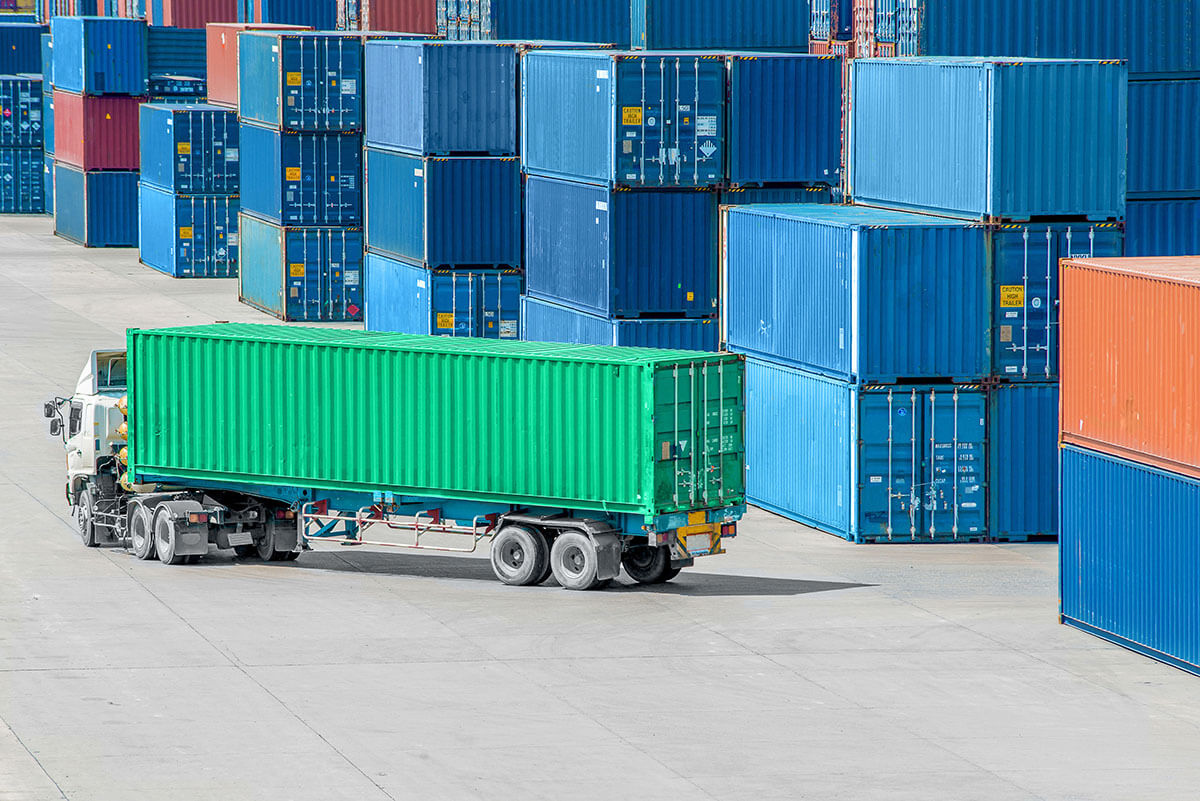
Trucks handle the first and last leg of almost every container move. The short haul between your facility and a port or rail terminal is called drayage. For loaded containers on public roads, the standard setup is a container chassis: a trailer frame with twist-locks or pin-locks that engage the four bottom corner castings of the container.
Rail
For long domestic distances, rail is usually more cost-effective than trucking the whole way. The container goes by truck to a rail ramp, by train to another ramp, and by truck to its destination. In North America, Class I railroads including Union Pacific, BNSF, CSX, and Norfolk Southern run intermodal service, with regional short lines feeding traffic into their networks.
Ocean
Ocean freight starts with a booking through a carrier, freight forwarder, or NVOCC. You supply cargo details, container type and size, and sailing dates. Then you deliver the container and its documents before the cutoffs the carrier and terminal set for that sailing. At the port, terminal operators handle storage, lifting, and tracking, and terminal handling charges apply. For the full export process, see our guide on how to ship a container overseas.
Inland waterway
Where a major river connects origin and destination, barge service can move containers at a lower cost than road. It only works where the waterway and terminals line up with your route.
One mode that isn’t on this list: air. Standard ISO containers don’t fly. Air cargo moves in its own unit load devices, so if you’re shipping by air, our guide to protecting air cargo from moisture damage covers that separately.
Which Truck Moves a Shipping Container?
The right equipment depends on the container’s size and weight, whether it’s loaded, and what the delivery site looks like.
| Equipment | Best for | Main advantage | Main limitation |
|---|---|---|---|
| Container chassis | Loaded containers to and from ports and rail terminals | Locks to the corner castings; the standard for intermodal road moves | Needs a crane, reach stacker, or side-loader to lift the container on and off |
| Tilt-bed (roll-off) truck | Delivering empty containers to a property | Slides the container to the ground with no crane | Needs long, straight access and overhead room |
| Flatbed trailer | Relocating containers | Flexible and widely available | Needs lifting equipment at both ends |
| Side-loader | Tight sites where a tilt-bed can’t back in | Lifts the container off and sets it beside the truck | Needs open space alongside the truck |
| Crane | Precise placement, or lifting over obstacles | Places a container where no truck can reach | Highest cost and the most coordination |
A note on twist-locks, since the term gets misused: they lock the container to the chassis or to another container. They don’t secure anything inside it. U.S. rules require every lower corner of an intermodal container to be locked to the chassis with devices that can’t unfasten in transit, with the front and rear secured independently (49 CFR 393.126). Cargo inside the box needs its own securing, covered below.
How Much Does a Shipping Container Weigh?
Three ratings matter, and mixing them up is the most common beginner error.
- Tare weight: the empty container.
- Payload: the most cargo the container is rated to carry.
- Maximum gross weight: the container plus its cargo, at the top of its rating.
The number you’ll calculate yourself is the gross weight of your shipment:
Gross weight = tare weight + cargo + pallets, packaging, dunnage, and securing materials
| Container | Exterior (L × W × H) | Interior width × height (approx.) |
|---|---|---|
| 20 ft standard | 20′ × 8′ × 8’6″ | 7’8″ × 7’10” |
| 40 ft standard | 40′ × 8′ × 8’6″ | 7’8″ × 7’10” |
| 40 ft high cube | 40′ × 8′ × 9’6″ | 7’8″ × 8’10” |
Weights vary by manufacturer, container type, and age. One carrier’s spec sheet lists a 40 ft dry container at 30,480 kg (67,200 lb) maximum gross weight and 26,630 kg (about 58,700 lb) payload. Published 20 ft ratings vary even more from unit to unit.
So don’t plan around a published average. Use the markings on the container itself: the door shows its maximum gross and tare weight, and the CSC safety approval plate confirms the rating for that specific unit.
Why a Container Can Be Legal at Sea and Overweight on the Road
A container rated for 67,200 lb gross can’t carry that on a U.S. highway, because the road limit applies to the whole truck, not the box.
On the Interstate System, federal limits are 80,000 lb gross vehicle weight, 20,000 lb on a single axle, and 34,000 lb on a tandem axle group, with bridge formula rules layered on top (FHWA). Subtract the tractor, the chassis, and the empty container, and the practical cargo ceiling for a standard setup is commonly cited at around 43,000 to 44,000 lb. Your exact figure depends on the truck and chassis.
That gap catches first-time shippers. A load the ship would accept can still be too heavy to drive to the port. Weight also decides:
- Which truck and chassis the carrier sends
- Axle loads, which depend on where the weight sits inside the box. Uneven loading can put one axle group over its limit even when the total is legal.
- Whether you need a permit
- Which crane or forklift can lift the container at each end
If your cargo runs past the road limit, the usual answers are splitting it across two containers or moving it with heavy-haul equipment under an overweight permit, where the route allows.
Do You Need a Permit to Transport a Shipping Container?
Not automatically. A standard container on a standard chassis, within legal weight limits, doesn’t need an oversize or overweight permit. Federal rules allow a maximum width of 102 inches (8.5 ft) on the National Network, and a standard container is 8 ft wide.
You may need a permit when the complete vehicle and load exceeds the weight, axle, width, height, or length limits on your route. That can happen with an overweight container, a high cube on a trailer that pushes overall height past a state’s limit, or a modified container with attachments that stick out.
The federal government doesn’t issue these permits. States do, and fees, escort rules, and travel-time restrictions vary by state and route. Your carrier usually files for the permit, but you’re the one who knows the cargo weight, so give them accurate numbers up front.
What Is Verified Gross Mass (VGM)?
If your container is going on an ocean vessel, it needs a VGM. Since July 1, 2016, the SOLAS convention has required the shipper to declare the verified gross mass of every packed container before it’s loaded onto a ship. A container without one doesn’t get loaded.
There are two approved ways to get the number:
- Method 1: weigh the packed, sealed container on calibrated equipment.
- Method 2: weigh all the cargo, packages, pallets, dunnage, and securing materials, then add the container’s tare weight, using a method approved by the country where the container is packed.
Estimating isn’t allowed. The shipper named on the bill of lading carries the responsibility, even when a forwarder or packing facility submits the figure (Maersk VGM FAQ).
How to Prepare a Shipping Container for Transport
Inspect before you load. A damaged container can let water in, fail during a lift, or get rejected at the terminal gate.
- Exterior: roof, walls, and corner castings free of holes, cracks, serious corrosion, and deformation
- Doors: hinges, locking bars, and cams work, and the door gaskets are intact and seal fully
- Light test: stand inside with the doors closed. Any daylight means a hole that will let water in.
- Floor: sound and dry, with no soft spots or protruding nails
- Interior: clean, dry, and odor-free, with no residue from the last cargo
- CSC plate: present, with a valid examination date or approved continuous examination program (ACEP) number
Then document it. Photograph the empty container, the loaded container before the doors close, and the sealed doors with the seal number visible. If anything arrives damaged, those photos support the claim.
How to Load and Distribute Cargo
Weight distribution affects the truck’s axle loads, the safety of every lift, and how stable the cargo stays in transit. The CTU Code, the IMO/ILO/UNECE code of practice for packing cargo transport units, calls for spreading weight evenly and avoiding concentrated or off-center loads.
Do:
- Spread weight across the floor, keeping the center of gravity near the middle of the container and as low as possible
- Load heavy items on the bottom and lighter items on top
- Put timber or load spreaders under heavy, concentrated items so one spot of the floor doesn’t carry the whole load
- Plan the load before you start, so any voids end up where you can fill them
Don’t:
- Load everything at one end or along one wall
- Stack heavy goods on light or crushable packaging
- Leave gaps that give cargo room to build momentum
How to Secure Cargo Inside a Shipping Container
Heavy cargo still moves. In transit it’s pushed forward and back under braking and acceleration, side to side through turns and a rolling vessel, and up and down over bumps and swells. Weight alone holds nothing in place.
On U.S. roads, FMCSA rules require cargo to be firmly immobilized or secured with structures of adequate strength, dunnage or dunnage bags, shoring bars, tiedowns, or a combination of these (49 CFR 393.106). The CTU Code sets out the same principles for the full intermodal trip.
- Blocking: pack cargo tight against the container walls, or against fixed timber, so it can’t slide.
- Bracing: use timber or other supports to transfer force from the cargo into the container’s structure.
- Lashing: tie cargo to the container’s lashing points with straps, chains, or wire rated for the load.
- Dunnage and dunnage bags: fill the gaps between cargo units, and between cargo and the doors, so nothing has room to shift.
- Anti-slip mats: add friction between cargo and floor, which reduces the lashing you need.
Never use the doors to hold back the load. They aren’t built for it, and whoever opens them at destination is standing in front of whatever shifted.
Why Moisture Is the Transport Risk Most Guides Miss
A sealed container keeps rain out. It doesn’t keep moisture out, because the moisture is already inside: in the air you closed in, in wood pallets and dunnage, in cardboard, and often in the cargo itself.
As the container heats and cools during the trip, that moisture moves. When the steel walls and roof cool below the dew point of the air inside, water vapor condenses into droplets that run down the walls and drip from the ceiling onto your cargo. That’s container rain. Shipping references separate container sweat, which forms on the container’s inside surfaces, from cargo sweat, which forms on the cargo itself, typically when cold cargo meets warmer, humid air.
The route matters as much as the cargo. A container loaded on a humid afternoon, left in a cool yard overnight, carried across an ocean, and unloaded in a tropical port can cross its dew point many times before anyone opens the doors.
Common moisture sources:
- Humid air at the loading site
- Wood pallets, crates, and dunnage
- Cardboard and paper packaging
- Hygroscopic cargo such as agricultural commodities
- Leaks through damaged doors, gaskets, or roofs
The damage shows up as rust on metal parts, stained or collapsed cartons, peeling labels, and mold on organic goods. The CTU Code gives condensation its own annex for that reason. For the full mechanics, see why moisture damage happens and how to stop condensation in a shipping container.
How to Protect Cargo During Container Transport
Match the protection to the risk. Three approaches cover most shipments, and each solves a different problem.
Moisture control removes water vapor from the container’s air before it condenses, and catches what does. Hybag container desiccants hang along the container walls and absorb moisture through the trip. Hyblanket desiccant blankets hang over the cargo, covering the pallets so drips from the roof never reach them. Hypad desiccant pads sit on the container floor and under pallets, absorbing moisture from below.
Temperature stabilization slows how fast the cargo heats and cools, which protects heat-sensitive goods and cuts the swings that drive condensation. Temcore liners line the container, and Temcore blankets and Temcore covers wrap palletized loads. A steel box in the sun gets hotter than most shippers expect; how hot shipping containers get explains why.
Contamination prevention keeps cargo off the container’s walls and floor. Container liners isolate the load, and for dry bulk they turn the container into a sealed bulk vessel.
| Risk | What it does to cargo | Protection |
|---|---|---|
| Humidity and container rain | Rust, mold, wet cartons, stained goods | Hybag desiccants, plus Hyblanket over the cargo |
| Large temperature swings | Heat damage and heavier condensation | Temcore liners, blankets, or covers |
| Residue or odor from the container | Contaminated or tainted product | Container liners |
| Dry bulk cargo | Spillage, contamination, slow discharge | Kratobag bulk liners |
| Long transit through several climates | Several of the above at once | A combination, specified for the route |
No single product removes every risk. The right mix depends on your cargo, packaging, route, season, and transit time, which is why we specify protection shipment by shipment rather than selling one product for every load. To confirm conditions held up in transit, humidity indicator cards or a data logger in the container give you a record at the other end.
How to Prepare the Delivery Site
Before the truck dispatches, check the route the truck has to take, not just the spot where the container will sit.
- Straight-line length: a tilt-bed pulls forward as the container slides off. Delivery providers commonly ask for about 60 ft of straight access for a 20 ft container and 100 to 120 ft for a 40 ft.
- Width: roughly 10 to 12 ft along the whole route in, including gates.
- Overhead clearance: at least about 14 ft, since the tilted bed raises the container well above its own height. Check power lines, tree limbs, and archways.
- Turning room: gates, corners, driveway entrances, and soft shoulders.
- Ground: firm, level, and well-drained. Soft ground can bog down the truck, and uneven ground can twist the container so the doors bind.
- Door orientation: decide which way the doors face before delivery. Turning a container once it’s down is not simple.
Set the container’s corners on level supports, such as concrete pads or treated timber blocks, so it sits square and off the wet ground. Clearance requirements vary by provider and equipment, so confirm the exact numbers with your carrier before you book.
How Shipping Containers Are Unloaded
The truck that brings the container can’t always place it where you want it. Match the unloading method to the site.
- Tilt-bed: the bed tilts and the container slides to the ground as the truck pulls forward. Best for open sites with long, straight access.
- Side-loader: hydraulic arms lift the container off the side of the trailer and set it alongside. Best where a truck can’t back in.
- Crane: lifts the container into place, including over fences and buildings. Best for difficult access or precise placement.
- Flatbed with a crane or forklift: the container stays on the trailer until a separate machine lifts it off. Only lift with a forklift rated for the weight, and only by the fork pockets where the container has them.
At ports and rail terminals, reach stackers, straddle carriers, and gantry cranes do this work. Any lift needs a qualified operator, rated lifting gear, and a clear exclusion zone around the load.
How Much Does It Cost to Transport a Shipping Container?
There’s no reliable flat rate, because the price is built from variables. The main ones:
- Distance and route
- Container size, and whether it’s empty or loaded
- Cargo weight
- Truck and chassis type
- Crane or side-loader requirements at either end
- Permits, tolls, and fuel
- Terminal handling and storage
- Waiting time at the site or the terminal
- International freight charges, for export moves
A useful way to read a quote: base trucking + mileage + equipment + permits + handling + site requirements + terminal and storage charges.
Then watch for the charges that surprise beginners:
- Demurrage: charged when a container stays inside the terminal past its free time.
- Detention: charged when you keep the carrier’s container outside the terminal past its free time.
- Per diem: a term used for both detention and chassis rental, depending on who’s billing. Ask which one you’re being quoted.
Free time varies by carrier, terminal, and contract. Get every quote itemized, and ask how many free days you have before the clock starts.
Who Handles What in a Container Move
Responsibility depends on your contracts and the terms of sale, but this is the usual split:
| Task | Usually handled by |
|---|---|
| Packing, loading, and securing cargo inside the container | Shipper |
| Moisture and temperature protection for the cargo | Shipper |
| Declaring the VGM for ocean shipments | Shipper |
| Locking the container to the chassis and staying road-legal | Trucking carrier |
| Route planning and permits | Trucking carrier, using the shipper’s weight figures |
| Lifting, storage, and handling at the port | Terminal operator |
| Stowage on the vessel | Ocean carrier |
The pattern is worth noticing. Almost everything that happens inside the container is on the shipper. The carrier moves the box; you protect what’s in it.
Common Container Transport Problems and How to Prevent Them
| Problem | Usual cause | Prevention |
|---|---|---|
| The truck can’t reach the site | Not enough straight access, width, or overhead room | Measure the full route in and share it with the carrier |
| The container is too heavy for the road | Cargo plus container plus truck exceeds weight or axle limits | Calculate gross weight before loading; split the load if needed |
| Cargo shifts in transit | Gaps, weak blocking, or too little lashing | Block, brace, and fill voids before closing the doors |
| Cargo arrives wet or moldy | Condensation, damp packaging, or a leaking container | Inspect the container and add desiccants and absorbent blankets |
| Cargo arrives heat-damaged | Solar exposure and temperature swings | Use thermal liners, blankets, or covers |
| The delivery needs unplanned equipment | Site conditions weren’t shared up front | Send photos and measurements when you book |
| The shipment is delayed | Permits, terminal congestion, missing VGM, or documents | Confirm cutoffs and paperwork before pickup |
The easiest problem to prevent is the one decided before the doors close. Weight, securing, and moisture protection are all set at loading, and none of them can be fixed in transit.
Shipping Container Transport Checklist
Before booking
- Confirm the container size and type
- Record the tare weight from the container doors
- Calculate the cargo weight and the gross weight
- Choose the transport mode
- Confirm pickup and delivery addresses
- Check site access, overhead clearance, and ground conditions
- Confirm the unloading equipment
- Check permit requirements with the carrier
- Confirm the carrier’s liability and cargo insurance, and read the exclusions
Before loading
- Inspect the container inside and out, including the light test
- Check door gaskets and locking bars
- Clean and dry the interior
- Plan the load and weight distribution
- Prepare blocking, bracing, lashing, and dunnage
- Plan moisture and temperature protection for the route
Before departure
- Confirm the cargo is secure and nothing rests on the doors
- Confirm the gross weight and submit the VGM for ocean shipments
- Confirm all documents are complete
- Apply the seal
- Record the container number and seal number
- Photograph the loaded container and the sealed doors
- Confirm pickup and delivery instructions with the carrier
Frequently Asked Questions
How do you transport a shipping container?
Choose a transport method, confirm the gross weight against road and vessel limits, inspect and load the container, secure the cargo, and plan the delivery site. Loaded containers move on a container chassis by road, often combined with rail or ocean legs. Empty containers are usually delivered by tilt-bed truck.
What type of truck is used to transport shipping containers?
Loaded containers usually ride on a container chassis that locks to the four bottom corners. Empty containers headed to a property usually arrive on a tilt-bed truck. Flatbeds, side-loaders, and crane trucks handle sites where a tilt-bed won’t fit.
Can a shipping container be transported while loaded?
Yes. That’s what containers are built for, provided the gross weight stays within road and axle limits and the cargo is secured inside. Many tilt-bed delivery services will only drop empty or lightly loaded containers, though, so ask before you book.
How much does a shipping container weigh?
It depends on the unit. One carrier lists a 40 ft dry container at 30,480 kg (67,200 lb) maximum gross weight with about 58,700 lb of payload. Check the container’s door markings and CSC plate for the actual figures.
Can I move a shipping container myself?
Moving one on public roads takes heavy equipment and, for most setups, a commercially licensed driver. Hire a licensed carrier for the move, and put your own effort into weight, loading, and cargo protection.
Do you need a permit to transport a shipping container?
Not for a standard container within legal weight limits. A permit comes into play when the vehicle and load exceed weight, width, height, or length limits on the route, and states issue those permits, not the federal government.
What is verified gross mass (VGM)?
It’s the confirmed weight of a packed container, which the shipper must declare before the container is loaded onto an ocean vessel. It’s measured by weighing the packed container, or by weighing every item inside and adding the container’s tare weight.
How do you prevent condensation inside a shipping container?
Start with a clean, dry, watertight container and dry packaging. Then add container desiccants to absorb moisture, absorbent blankets over the cargo to catch drips, and thermal liners or covers when the route has large temperature swings.
Does a shipping container protect cargo from extreme temperatures?
Not on its own. A steel container absorbs solar heat and loses it fast at night, so the air inside can swing widely. Thermal liners, blankets, and covers slow those swings.
How long does it take to transport a shipping container?
It depends on distance, mode, and route. A local delivery can take a day, while an international move adds terminal cutoffs, sailing schedules, ocean transit, and customs. Build in a buffer, since every day past free time can add demurrage or detention.
Getting the Box There Is Half the Job
A carrier can get your container to its destination on schedule. Whether the cargo inside arrives in sellable condition is decided at loading: by how it’s secured, and how it’s protected from the moisture and heat it will meet along the way.
That second part is what we do. Tell us your cargo, container size, route, and transit time, and our team will specify the moisture, temperature, and contamination protection that fits the shipment. Contact our experts to request a solution.


