

;)
When shipping cargo overseas, moisture control is essential. Excess moisture in your shipping container can cause container rain, cargo damage, rust, corrosion, mildew, and more. To protect your shipment and ensure safe arrival, it’s essential to use moisture-controlling desiccant.
Read on to learn all about desiccant packs, including how they work, the different types of desiccant, and how long desiccant packs last.
What are Desiccant Packs and How Do They Work
Desiccant packs are bags filled with moisture-absorbing materials like silica, calcium chloride, and other absorptive materials. They’re used to absorb moisture and control humidity levels in a given space, preventing damage to individual goods, cargo, packaging, and more.
Desiccant packs come in a range of different sizes to support different needs. Most are familiar with the small silica gel packs that come in retail goods like shoes, electronics, and more. For industrial use, like to control humidity in shipping containers, shippers use industrial-grade desiccant bags and blankets.
Desiccant packs work using two different mechanisms: absorption and adsorption:
- Absorption: If you’ve ever used a sponge to sop up extra moisture, you’re familiar with the process of absorption. When a substance absorbs moisture, it draws the moisture inside of it, until it’s ultimately filled with moisture.
- Adsorption: During adsorption, the moisture is attracted to the surface of the substance, but doesn’t enter. Instead, the moisture simply accumulates on the outside.
Depending on the type of desiccant, it may function using either the process of absorption or adsorption. For instance, silica gel packets absorb moisture, while molecular sieves adsorb.
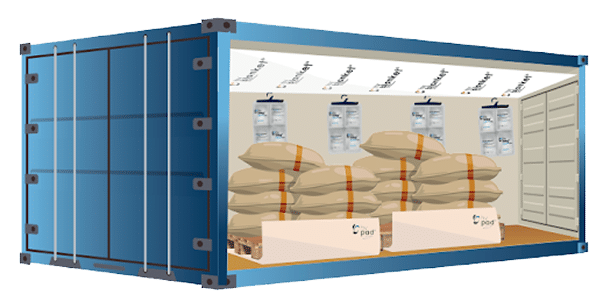
Factors that Determine Desiccant Pack Lifespan
In addition to the desiccant materials, there are a range of external factors that determine how long desiccant bags last in cargo containers. They include:
- Humidity levels: Each desiccant only has a finite absorption capacity. That means, the higher the level of humidity in the atmosphere, the faster a desiccant saturates and the shorter it lasts. High humidity levels may come from the environment, like travel through particularly humid regions, significant temperature swings, which leads to condensation, or even cargo that emits a lot of humidity, like wood, textiles, or perishables.
- Temperature: Higher temperatures can cause cargo to release humidity more quickly, increasing the humidity in the atmosphere. When the external temperature exceeds dewpoint, condensation occurs and humidity skyrockets.
- Container airtightness: For ocean travel, the airtightness of a cargo container can dramatically impact humidity, and therefore how long a desiccant lasts. If a container has cracks, leaks, faulty seals, or other issues, moisture in the shipping container can skyrocket.
Types of Desiccant Packs and How Long They Last
Desiccant pack lifespan can vary greatly depending on the type of desiccant. Read on to learn all about the various types of desiccant packs and how long they last.
Shelf Life vs. Active Use
When it comes to determining how long desiccant packs last, it’s important to distinguish between desiccant pack shelf life and how long a desiccant pack lasts in active use:
- Shelf life: When sealed in storage, most desiccant packs and desiccant bags can last between 1 and 3 years.
- Active use: When in active use, desiccant packs can last anywhere from a few weeks to a few months, depending on the desiccant type and external conditions.
Silica Gel Desiccant
Silica gel desiccant bags are made from silicon dioxide. It adsorbs moisture by attracting it to its surface, where the moisture becomes trapped in its pores. Silica gel can absorb up to 40% of its weight in moisture.
- Ideal temperature range: 70°F to 90°F
- Lifespan in moderate humidity: Silica packets last about 6 months in 40% to 50% humidity
- Ability to reuse: Can be dried out and reused
Calcium Chloride Desiccant
Calcium chloride is another common type of desiccant for shipping containers. It’s a hygroscopic material, meaning it’s attracted to water, and absorbs excess moisture in the atmosphere. Calcium chloride is an extremely effective desiccant; it can absorb up to 300% of its own weight in moisture.
- Ideal temperature range: 23°F to 194°F
- Lifespan in moderate humidity: In moderate humidity (40% to 50%), calcium chloride desiccant bags last up to 90 days.
- Ability to reuse: Cannot be reused
Molecular Sieve Desiccant
Molecular sieves are often made from metal oxides, sodium, potassium, and other elements. These desiccants adsorb moisture in the atmosphere and trap it on their surface. Unlike other types of desiccant, molecular sieves are designed to attract certain size molecules, meaning they can adsorb some types of moisture without disturbing others. They can adsorb up to 20 times their weight.
- Ideal temperature range: 77°F to 150°F
- Lifespan in moderate humidity: Molecular sieve desiccants last a few weeks at 40% to 50% humidity
- Ability to reuse: Can be dried out and reused
Signs Desiccant Packs Have Maxed Out
Wondering if your desiccant packs have absorbed their maximum amount of moisture? The following are signs that your desiccant packs may be spent:
- Color change: Some types of desiccant have a moisture indicator that changes color when fully saturated. For example, depending on the type of silica gel, it may turn from blue to pink, orange to green, or clear to white when it’s maxed out.
- Lumpy texture: Your desiccant bags may also change in texture when they’ve reached their maximum absorption capacity.
- Moisture droplets: Visible water droplets on the surface of your desiccant may be another sign that they can’t absorb any more water.
- Container damage: Rust, corrosion, mold, and other types of moisture damage in your container or on your products are a sign that your desiccant bags were pushed beyond their max.
How to Choose the Best Desiccant For Your Shipping Container
Choosing the best desiccant for your shipping container begins with understanding your cargo and its specific needs. Consider these factors when selecting your desiccant:
- Cargo type: Moisture-sensitive cargo like electronics or cargo that releases moisture, like agricultural products, require long-lasting desiccant.
- Trip duration and climate: Lengthy trips, as well as ones that travel through humid climates or undergo significant temperature swings will require more effective desiccants.
- Container size: The larger your container, the more desiccant you’ll need.

EPGNA: Your Source For High Quality, Long Lasting Desiccant Packs
Determining the specific lifespan of desiccants depends on the desiccant type, environment, application, and other factors. For shipping containers, it’s essential to use high-capacity desiccants to ensure safe arrival.
EPGNA humidity control products provide the moisture control your cargo needs to survive its journey. Our products are high-absorption and optimized for containerized cargo. Contact us today to learn how EPGNA can help.


